
Persistent gaps in representation across technology- and science-focused careers continue to challenge U.S. colleges and universities with STEM programs. Many science and technology fields continue to lack diversity, with students from low-income, first-generation, and rural backgrounds facing persistent barriers to entry and advancement. These students often have less access to foundational STEM experiences, including hands-on research, updated laboratories, internet connectivity, and career-planning support. Even when they pursue postsecondary education, long-term success in STEM requires access to mentors, peer networks, and confidence-building opportunities.
To help address these challenges and prepare students for college-level STEM success, the University of Maryland Eastern Shore School of Pharmacy (UMES-SOP) launched the Maryland Action for Drug Discovery and Pharmaceutical Research (MADDPR) program in 2019 with funding from the National Institutes of Health (NIH) and the National Institute of General Medical Sciences. MADDPR introduces high school students to advanced research concepts in biomedical science and drug discovery, while also equipping them with critical skills in laboratory methodologies and instrumentation. Research shows that early exposure to biomedical research increases students’ likelihood of success in STEM disciplines, and the Lemelson-MIT Invention Index has found that hands-on learning outside the classroom is especially effective at engaging youth ages 12–17.
Each year, approximately 50 students from a local Eastern Shore school district participate in MADDPR’s university-based curriculum. Students gain real-world experience in drug discovery and biomedical research through guided activities led by pharmaceutical scientists, supported by Doctor of Pharmacy and PhD graduate students. Participating teachers are also involved in the program, ensuring continuity between classroom learning and lab-based research exploration.
In addition, the high school students participate in a mentorship program, also referred to as a buddy support system. In groups of six to eight, the high schoolers work with graduate students for training and support during and after the program ends. This continuing support with near-peer role models encourages the high schoolers to stay focused on moving forward with their STEM career plans and provides guidance on college readiness.
Another important aspect of this program is the participation of the high school science teachers. Through this participatory research training program, the high school science teachers have been able to enhance their educational experience and obtain the tools to enable them to more effectively teach their students about new research methodology and STEM careers. The expected outcome of this NIH-science education partnership award (SEPA)-funded program is to foster the students’ critical thinking skills and stimulate their interest in and pursuit of pharmaceutical, health-related, and biomedical research careers.
“I learned about different options for my career at UMES (University of Maryland Eastern Shore). Now that I know these options exist, I feel more inclined to go here. I also learned about different aspects of the job as a pharmacist, which is what I want to be.”
Student participant
“I find this [Maryland Action for Drug Discovery and Pharmaceutical Research] camp to be extremely valuable to my students. It is structured to introduce many of the topics that we cover in class that I can expound upon later. My students absolutely love it as do I.”
High school science teacher
“Partnership [with the University of Maryland Eastern Shore] opens another door for our students. We’re thrilled about the exposure [students will] be getting as well as the professional development opportunities for our teachers. Having our students on the [University of Maryland Eastern Shore] campus is such a shot in the arm and a validation that our biomed program is on the right track.”
Dr. John Gaddis, superintendent, Somerset County Public Schools
The Methodology
UMES-SOP had certain criteria for the selection of the school district with which it partnered and the development and execution of its curriculum. The university targeted students from Somerset County, a rural county with limited access to educational and economic opportunities for even the lower shore of Maryland. Only 15% of high school graduates in this area successfully pursue postsecondary education compared with 38% for the state; the high school dropout rate is 20% compared with 11% statewide. One of the target public high schools in Somerset County, Washington Academy High School & Academy in Princess Anne, has excellent diversity with 41% white, 49% Black, and 1.2% Asian. Most students in this school are provided free or reduced-price lunches, alluding to the economic and financial hardships their families face.
The participating high schoolers in grades nine to 11 were exposed to research-based learning in a UMES-SOP setting for a summer camp, which afforded access to state-of-the-art educational and technological resources. A comprehensive curriculum was developed by participating faculty with input and feedback from high school teachers involved with the national Project Lead The Way Biomedical Science program, a nonprofit organization that designs and applies skills by exploring real-world challenges. Through modules, students learn from established pharmaceutical researchers about their work, participate in hands-on research activities relevant to the students’ backgrounds and lived experiences, and explore pharmacy profession practice areas, health literacy, and kinesiology. The lab modules included a diverse set of topics: drug design & synthesis, biomarkers, pharmaceutical compounding of capsule dosage forms, opioid abuse and prevention, retail pharmacy operations, kinesiology experiments, promoting healthy behavior and disease prevention, hospital pharmacy operations, animal behavior software, prostate cancer, COVID-19 diagnosis and vaccines, nanoparticles for targeted drug delivery, dosage form design by 3D-printing, understanding viral infections, drug analysis by HPLC/MS, and antibiotics discovery research. Course instructors and near-peer mentors who work together to deliver these modules are also culturally diverse to meet the target students’ social, cultural, and linguistic needs. Upon the completion of the program, the students continue to engage with their mentors and seek their guidance in choosing a college and a specific academic training pathway among STEM majors.
The program activities and expected outcomes are assessed based on a logic model and cultural competency, which consider the context of the research-based ideas and the diversity of the student group with limited exposure to these ideas. The success of the MADDPR project is determined through a comparative analysis of pre- and post-program surveys of student learning and engagement. Through the SEPA program, the students are expected to have strengthened their noncognitive skills such as self-efficacy—increased confidence in science—and to commit to lifelong learning that can boost their retention in STEM disciplines and ensure long-term success in STEM-related fields.
The Impact
UMES aims to use the SEPA program to cultivate a pipeline of motivated URM students who choose this institution to pursue a major in a STEM area and diversify the biomedical and clinical research workforce. With the support of their mentors, these students can consider and select from among the accelerated pathways to college education (e.g., dual enrollment) or to professional degree programs (e.g., pharmacy, physical therapy, physician assistant, kinesiology, and rehabilitation services). In addition, the program allows for professional development opportunities for participating faculty and high school teachers to enhance their instruction and support of students, as well as mentorship training for near-peer student mentors.
The initial findings of the MADDPR program have been promising. Among them are:
- Survey data indicate that students completing the program are more focused to explore STEM education and career paths at 88%, remain interested in health professions at 96%, and pursue four-year college education at 83%.
- The strong collaboration between the program administrators and Somerset County Public Schools has resulted in the successful recruitment of high school students annually for the past four years.
- The hands-on summer biomedical enrichment program has been reaching approximately 50 high school students per year since 2019.
- The program successfully implemented virtual instruction in 2020 and in-person instruction in 2021 and 2022 during the COVID-19 pandemic.
Work is in progress to gather National Student Clearinghouse data to track the educational pathways of MADDPR program participants upon graduation from high school and to structure the program to be a college pipeline. These successes have motivated UMES not only to continue the MADDPR Program in Somerset County Public Schools but also to plan to extend the program to other counties in Maryland.
Key Takeaways
The MADDPR program model is a viable innovative approach to stimulate prospective undergraduate student interest in STEM and biomedical sciences. This adaptable model could be applied to any environment with similar historically underrepresented student populations to help improve college access and retention. Getting students excited about science and college using out-of-school time and hands-on learning engagement with mentoring support is the key to this program’s success. One unique feature of the program is its offering of a diverse set of topics, which keeps the students’ interest and motivation high. The program builds upon the collaboration with the local school district and its educators, draws on and contributes to best practices in science education, and meshes with Next Generation Science Standards. These research-based standards for K–12 students help educators develop learning experiences that stimulate students’ interests in science and prepare them for college and careers.
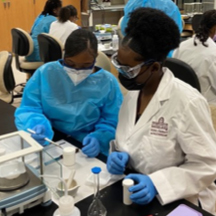
University of Maryland Eastern Shore science education partnership research students tackle
SEPA high school students from UMES MADDPR working together with SEPA students from the University of Maryland “CURE” program during a joined lab session on pharmacy compounding.
Second-year University of Maryland Eastern Shore science education partnership research participant presenting her 2021 summer camp experience